War Starts at Midnight!

War Starts at Midnight!

Reviews

Don’t be put off by the title. The Life and Death of Colonel Blimp (1943) is one of the finest British films ever made.

Based on the popular Colonel Blimp political cartoon that satirized Britain’s military establishment, Winston Churchill was so worried the film would send the wrong wartime message to British and American audiences he tried to stop it in mid-production.

Michael Powell and Emeric Pressburger, the film’s co-directors, had hoped to use Laurence Olivier in the title role of Clive Candy, but the Ministry of War refused to release Olivier from military duty. In his place, Powell and Pressburger chose Roger Livesey, who gives a remarkable performance that convincingly portrays Candy over a 40-year period encompassing three wars.

Churchill allowed the film to be released in Britain in July 1943, but held up its release to the U.S. until 1945. That version was 10 minutes shorter than the British version (153 minutes versus 163 minutes). After an unsuccessful run, the U.S. print was trimmed to 93 minutes and wasn’t seen uncut in either England or the United States until the 1970s.

While the controversy over the Blimp character is important for understanding the context of the movie, it’s the excellent performances, as well as the subtle direction and intelligent script by Powell and Pressburger, that make this a real standout. Here are some examples of the dialogue:

Hoppy: I was awfully sorry to hear about your leg. [Looks down] Jumping Jehosaphat! They’re both there!
Clive Candy: What the hell did you think I was standing on?
Hoppy: They told me in Bloemfontein that they cut off your left leg.
Clive Candy: [Examines leg] Can’t have, old boy. I’d have known about it.

Clive Candy: The Kaiser spoke — and the Prince of Wales spoke . . .
Edith Hunter: Spoke about what?
Clive Candy: Nobody could remember.

Clive Candy: Well sir, I have a friend . . .
Colonel Betteridge: Good. Not everybody can say that. Continue!

Clive Candy: I heard all that in the last war! They fought foul then — and who won it?
Theo Kretschmar-Schuldorff: I don’t think you won it. We lost it — but you lost something, too. You forgot to learn the moral. Because victory was yours, you failed to learn your lesson twenty years ago and now you have to pay the school fees again. Some of you will learn quicker than the others, some of you will never learn it — because you’ve been educated to be a gentleman and a sportsman, in peace and in war. But Clive! [tenderly] Dear old Clive — this is not a gentleman’s war. This time you’re fighting for your very existence against the most devilish idea ever created by a human brain — Nazism. And if you lose, there won’t be a return match next year. . . perhaps not even for a hundred years.

Clive Candy: War starts at midnight!

Filmed in London and the surrounding countryside during the Blitz, this is an epic film. It’s epic not just in its physical and temporal scale, but also in its ambitious themes. The story is an elegy on friendship and divided loyalties, on lost opportunities and an unwillingness to adapt.

Unlike the blustery and bullheaded Blimp of the political cartoon, this Blimp is sympathetic. At heart, he’s a good man who can admit his mistakes. Because he’s entirely human, and not a cardboard figure, the criticism of Churchill’s military rings truer that it might have otherwise.

The Life and Death of Colonel Blimp
(1943; directed by Michael Powell and Emeric Pressburger)
The Criterion Collection (DVD)

Sunday, February 1 at 11:30 a.m. eastern on Turner Classic Movies

Living on the Edge

Living on the Edge

Reviews

Only Angels Have Wings (1939) is one of Howard Hawks’ best and most personal films. Hawks was a master of taking on the conventions of a genre and adding deeper meaning to its clichéd elements. At the same time, he was able to reinvigorate the entertainment aspects of the genre, so the end result is a far richer film than you would expect. Only Angels Have Wings is a teeth-clinching adventure film about a band of outcast pilots who bravely agree to fly a South American mail run — in weather conditions that would turn back any other pilot.

As in later Hawks films, you’ll find the themes of loyalty, personal responsibility, and group cohesion. Underneath those themes is a web of complex personal relationships. And within those relationships, you’ll encounter the problem of how we deal with — or choose not to deal with — the issue of our own mortality.

In an interview published in the February 1956 issue of Cahiers du Cinéma, Hawks describes a scene where two of the pilots deal openly with the inevitability of death:

Adventure stories reveal how people behave in the face of death — what they do, say, feel, and even think. I have always liked the scene in Only Angels Have Wings in which a man says, ‘I feel funny,’ and his best friend says ‘your neck is broken,’ and the injured man then says ‘I have always wondered how I would die if I knew I was going to die. I would rather you didn’t watch me.’ And the friend goes out and stands in the rain. I have personally encountered this experience, and the public found it very convincing.

It isn’t all doom and gloom. Only Angels Have Wings has a central life-affirming message and plenty of lighthearted moments. The pilots enjoy themselves all the more because they understand life can be fleeting. The audience’s misgivings are embodied in the Bonnie Lee character played by Jean Arthur. While she is initially repulsed by the men who appear to be insensitive to the loss of their friends, she comes to realize (as we do) that this may be the only way they can do their jobs and remain sane.

No other adventure film, that I’m aware of, does a better of job of presenting both the good effects (intense personal friendships) and bad effects (emotional scaring) that flow from a constant exposure to danger. Even more impressive is the film’s exploration of the intricate interplay between the good and bad effects. Insight into the human psyche on top of an exhilarating adventure story — what more could you ask from a Hollywood film?

Only Angels Have Wings
(1939; directed by Howard Hawks)
The Criterion Collection (Blu-ray and DVD)

Thursday, January 15 at 10:15 p.m. eastern on Turner Classic Movies

Ham Sandwich

Ham Sandwich

Reviews

Lubitsch’s To Be or Not to Be (1942) was criticized at the time of its release for being too morbid and for taking a serious subject too lightly. Like Chaplin’s The Great Dictator (1940), it attacks Hitler and the Nazi movement with a broad brush. We would call this a black comedy, which is a film that takes an over-the-top, almost farcical approach to a sensitive subject. We’re quite comfortable with this style of comedy today, but in the 1940s, this type of satire in movies was still untested.

In his book Index to the Films of Ernst Lubitsch, Theodore Huff writes:

The Lubitsch burlesque, laid in Nazi-invaded Warsaw, was called callous, a picture of confusing moods, lacking taste, its subject not suitable for fun making. While others felt that such merciless satire and subtle humor were good anti-Nazi propaganda, the picture was, perhaps, ill-timed, doubly so as it opened not long after the death of Carole Lombard, killed in an airplane accident at the height of a brilliant career.

Based on an original idea by Lubitsch and Ninotchka-author Melchior Lengyel, To Be or Not to Be is the story of a small Polish theatrical troupe forced to shut down after the Nazi invasion. Actor Josef Tura (Jack Benny) suspects his wife Maria (Carole Lombard) may be cheating on him. Tura sees the same young Lieutenant (Robert Stack) leave his seat in the theater each night, just as he begins Hamlet’s soliloquy. After a series of comedic twists and turns, the acting group is called on to give the performance of a lifetime. They’ll have to impersonate their Nazi occupiers, or die trying.

The film is full of wonderful Lubitsch touches — nuggets of visual wit and clever dialogue. Memorable lines include:

Colonel Ehrhardt: They named a brandy after Napoleon, they made a herring out of Bismarck, and the Fuhrer is going to end up as a piece of cheese!

Greenberg: Mr. Rawitch, what you are I wouldn’t eat.
Rawitch: How dare you call me a ham?

Maria Tura: It’s becoming ridiculous the way you grab attention. If I tell a joke, you finish it. If I go on a diet, you lose the weight. If I have a cold, you cough. And if we should ever have a baby, I’m not so sure I’d be the mother.
Josef Tura: I’d be satisfied to be the father.

If all this sounds vaguely familiar, you may have seen Mel Brooks’ 1983 remake, also titled To Be or Not to Be. It follows the Lubitsch film almost scene for scene. Brooks takes the Jack Benny role, and Brooks’ real-life wife Anne Bancroft takes the Carole Lombard role.

To Be or Not to Be
(1942; directed by Ernst Lubitsch)
The Criterion Collection (Blu-ray and DVD)

Tuesday, January 6 at 6:15 p.m. eastern on Turner Classic Movies


Light and Shadow

Light and Shadow

Reviews

Rashomon (1950) might have been just a concept film — a fascinating idea trapped inside a mediocre movie. Instead, director Akira Kurosawa gave us a film that’s equally rich in character and imagery. It was so successful, the title became synonymous with its plot device, that four witnesses could recount radically different versions of the facts. Another director might have steered us toward the conclusion that one of the four versions is the true version. Kurosawa strives for a deeper understanding, that we inevitably filter reality through various psychological, social, and religious prisms.

While much is made of Rashomon’s inspired depiction of subjective truth, you rarely read about its other innovations. Compared with his previous efforts, including Drunken Angel (1948) and Stray Dog (1949), Rashomon represents a significant shift in Kurosawa’s approach to filmmaking.

In Something Like an Autobiography, Kurosawa explained how he wanted to recapture his childhood enthusiasm for film as a purely visual medium:

Since the advent of the talkies in the 1930s, I felt we had misplaced and forgotten what was so wonderful about the old silent movies. I was aware of the aesthetic loss as a constant irritation. I sensed a need to go back to the origins of the motion picture to find this peculiar beauty again; I had to go back into the past. In particular, I believed that there was something to be learned from the spirit of the French avant-garde films of the 1920s. Yet in Japan at this time we had no film library. I had to forage for old films, and try to remember the structure of those I had seen as a boy, ruminating over the aesthetics that had made them special. Rashomon would be my testing ground, the place where I could apply the ideas and wishes growing out of my silent-film research. To provide the symbolic background atmosphere, I decided to use the Akutagawa ‘In a Grove’ story, which goes into the depths of the human heart as if with a surgeon’s scalpel, laying bare its dark complexities and bizarre twists. These strange impulses of the human heart would be expressed through the use of an elaborately fashioned play of light and shadow.

The lights and shadows are enhanced by intricately orchestrated camera movements. Much like the camera movements in Sunrise (1927), Rashomon’s camera sometimes follows the characters, sometimes leads the characters, and sometimes moves in opposition to the characters. In Sunrise, the camera movements reflect the husband’s moral hesitation in meeting with the city woman. In Rashomon, the camera movements reflect the viewer’s struggle to find a common path through the four stories.

Kazuo Miyagawa, the film’s cinematographer, carefully mapped out the scenes where the viewer is led through the forest, often at breakneck speeds. Miyagawa broke with cinematic conventions when he aimed the camera directly at the sun as it moved in and out of the trees. The same effect was copied in Hollywood throughout the 1950s and 1960s, both for movies and television. Kurosawa and Miyagawa chose to photograph the Rashomon gate in pouring rain to enhance its bleakness. After running a series of tests and determining the rain wouldn’t be visible, they added black ink to the rain so it could be seen against the gray sky.

This movie improves with each viewing, not because the plot is overly complex, but because it has so much to offer visually, aesthetically, and philosophically.

Rashomon
(1950; directed by Akira Kurosawa)
The Criterion Collection (Blu-ray and DVD)

Friday, January 2 at 10:15 p.m. eastern on Turner Classic Movies

Well-Oiled Machine

Well-Oiled Machine

Reviews

Mildred Pierce (1945) is the kind of competently directed Hollywood film from the 1940s that seems better each time you watch it. Like Michael Curtiz’s other outstanding drama from that decade, Casablanca (1943), everything seems to click — uniformly fine performances, a terrific script that never misses a beat, and a first-rate musical score (Max Steiner in both cases).

Joan Crawford won the title role only after it was turned down by Bette Davis and Rosalind Russell. Shirley Temple was considered for the part of the teenaged daughter, Veda Pierce. Fortunately, fate (or good sense) prevailed, and it’s now hard to imagine anyone else in any of the roles. Ranald MacDougall, Catherine Turney, and an uncredited William Faulkner adapted the screenplay from the novel by James M. Cain. The movie downplays much of the sexual frankness of the novel, which Curtiz handles obliquely. You may recognize Cain as the author behind The Postman Always Rings Twice (1946).

A key strength of the film version of Mildred Pierce is that it doesn’t fit easily into a single genre. It begins with a murder and failed attempt to frame an innocent man — classic elements of a film noir. The distinct lighting and emotionally charged music also point to that genre. In the flashbacks, however, we’re thrown into an entirely different film genre, sometimes referred to as “weepies” or “women’s pictures.” Here we’re sympathetically drawn into the story of a woman struggling to give her children a better life. The arc of the film is the collision of these two types of movies. Ultimately, one of the genres has to win out, and it’s the interplay between the two storylines that makes this film especially appealing.

It’s also remarkable how the various elements mix together so seamlessly. The comic lines (delivered by Jack Carson as Wally and Eve Arden as Ida) reinforce what we’ve already learned about the characters. For example, Ida sums up Mildred and Veda’s relationship with this biting comment, “Personally, Veda’s convinced me that alligators have the right idea. They eat their young.” Similarly, Wally acknowledges his own failings when he says, “Oh boy! I’m so smart it’s a disease!”

While you can make a case against the restrictiveness of the Hollywood studio system, movies such as Mildred Pierce represent the best argument for the advantages. The film’s high-buff polish and overall consistency are a direct result of a well-oiled studio machine.

Mildred Pierce
(1945; directed by Michael Curtiz)
The Criterion Collection (Blu-ray)
Warner Home Video (DVD)

Friday, January 2 at 6:00 p.m. eastern on Turner Classic Movies
Fiercely Original

Fiercely Original

Reviews

For many years, I considered The Gold Rush (1925) to be my favorite Chaplin film. It has everything you would want in a great comedy: thrills (sliding off the edge of a cliff), romance (Georgia Hale is strikingly beautiful), imagination (a pretend dance using forks and potatoes), pathos (the tramp waiting for Georgia to attend his dinner), and intelligent humor (almost everywhere you look). These days I would choose City Lights (1931) as Chaplin’s best, but only because it’s more polished and consistent. I would still choose The Gold Rush as the best introduction to Chaplin — as long as the print quality is good, and it’s not the 1942 reissue version where Chaplin speaks all the titles and provides a running commentary. Unfortunately, the print quality is usually better with the 1942 reissue over the 1925 silent version.

Though fiercely original, Chaplin could still be influenced by other filmmakers. In his book Charlie Chaplin, author Theodore Huff describes how Chaplin may have absorbed ideas from other films:

The close to hysterical suspense of the scene of the cabin half over the cliff may show the influence of Harold Lloyd who started a vogue for comedy-thrill sequences in his “Safety Last” and other skyscraper pictures. It is Chaplin’s first use of such effects but, imitated or not, his inimitable touches make it his own. The happy ending of the film, which in some ways breaks the mood, may have been inspired by the epilogue of Murnau’s “The Last Laugh,” which was then influencing picture-making all over the world.

Chaplin considered The Gold Rush to be “the picture I want to be remembered by.” Huff estimated its production costs to be in the neighborhood of $650,000 (compared with $300,000 for The Kid). It was money well spent. The Gold Rush was one of the highest grossing films of the 1920s, bringing in $2.5 million domestically and another $2.5 million internationally. Chaplin received about $2 million, which was an extraordinary amount of money at the time.

Based on the listed running time (89 minutes), it appears that TCM has scheduled the 1925 version this time around. The Blu-ray and DVD packages from Criterion include both versions, which gives you a chance to experience the film from two different perspectives.

The Gold Rush
(1925; directed by Charles Chaplin)
The Criterion Collection (Blu-ray and DVD)

Sunday, December 14 at 8:00 p.m. eastern on Turner Classic Movies
Heaven on Earth

Heaven on Earth

Reviews

Wim Wender’s Wings of Desire (1987) is an unusual film. It’s the story of the guardian angels who watch over the citizens of Berlin. One angel (named Damiel) yearns to become mortal, so he can experience firsthand what humans see and feel. On one level, this film explores universal themes: the loneliness of being human, the walls (both real and psychological) that prevent us from communicating, and the power of love to break down those barriers. On another level, this film can be an emotional challenge as it immerses the viewer into the often distressed thoughts of others.

It’s a fascinating idea for a film that’s beautifully photographed by Henri Alekan, best known for creating the fairytale-like imagery from Jean Cocteau’s Beauty and the Beast (1946). The shots from the angels’ point of view are rendered in a luminous and tinted black-and-white, while the shots from the human point of view are rendered in color, adding an extra dimension to represent the additional qualities Damiel is seeking. There’s a terrific sequence in a library where a team of angels gently move from person to person hearing their thoughts and attempting to sooth their troubled souls. In another scene, an angel tries to dissuade a man from committing suicide. In several scenes, young children can sometimes see the angels, or at least sense their presence.

Peter Falk portrays himself in the film, as the actor known for playing the television detective Columbo. He is visiting Berlin to act in a film. Wisely, Wenders doesn’t overplay the film-within-a-film aspects of Falk’s role, but rather gives him a crucial part in the larger film that helps to bring many of the plot elements together.

This movie isn’t for everyone. The first half can be confusing as you maneuver your way through the fleeting human thoughts and sometimes swirling imagery. Director Wim Wenders and writer Peter Handke created much of the script on the fly, which gives the story an ethereal quality but can also make it hard to navigate. Let it wash over you, and don’t worry about connecting the dots. As the film progresses, you’ll soon find solid ground under your feet.

Wings of Desire
(1987; directed by Wim Wenders)
MGM Home Entertainment (Blu-ray and DVD)

Friday, December 12 at 1:45 a.m. eastern (late Thur. night) on Turner Classic Movies

Breaking the Rules

Breaking the Rules

Reviews

Sometimes the conventional wisdom is true. In this case, Citizen Kane (1941) really is one of the best films ever made. Another bit of conventional wisdom is that Welles wasn’t able to direct another great film after Kane. That bit of shared knowledge is not true.

Kane is the only film where Welles was given complete control — and close to unlimited resources — to make the film he wanted. But how could a 25-year-old novice pull off what many have called the great American film? Here’s how Welles explained it in a 1966 interview conducted by Juan Cobos, Miguel Rubio, and J. A. Pruneda for the French film magazine Cahiers du Cinéma:

I owe it to my ignorance. If this word seems inadequate to you, replace it with innocence. I said to myself: this is what the camera should be capable of doing, in a normal fashion. When we were on the point of shooting the first sequence, I said, ‘Let’s do that!’ Greg Toland answered that it was impossible. I came back with, ‘We can always try: we’ll soon see. Why not?’ We had to have special lenses made because at that time there weren’t any like those that exist today.

Kane is a virtual catalog of visual and aural film techniques that give it a level of energy few films are capable of sustaining. Yet the real accomplishment is the tight integration of those techniques. Yes, the techniques are there to impress the audience, but more importantly, they’re there to fill out the characters and story.

Welles was young, but no babe on the woods. The studio gave him complete freedom because of his meteoric rise in radio and the theater. His radio drama of War of the Worlds had literally scared some listeners into believing there was a real invasion from Mars. And he had earned the moniker, “Boy Wonder of Broadway,” by staging such experimental productions as a Macbeth set in Haiti with an all African-American cast, a modern-dress Julius Caesar, and a production of the jazz opera, The Cradle Will Rock.

In his article for Action Magazine 4 (1969), titled “Citizen Kane Revisited,” Arthur Knight wrote that Welles spent hundreds of hours studying past films, first at the Museum of Modern Art and later on the RKO studio lot. Welles was particularly drawn to John Ford’s films. He watched Stagecoach over and over again, in order to analyze each shot. Though he downplayed the notion in public, Welles knew how to break the rules because he had taken the time to learn the rules in the first place.

Welles brought almost all of Kane’s actors, as well as music composer Bernard Herrmann, from the theater. Being new to Hollywood, they were eager to show what they could do. Though a veteran of Hollywood, Greg Toland was the perfect choice for director of photography. He was just as willing to experiment.

It’s a wonder it all came together. Here the credit goes to Welles and fellow-screenwriter Herman J. Mankiewicz. Citizen Kane has a depth of character and narrative flow that matches its technical fireworks. If you haven’t seen it, don’t hesitate. It’s one of a handful of films that shows what the medium is truly capable of producing.

Citizen Kane
(1941; directed by Orson Welles)
Warner Bros. (Blu-ray), Turner Home Entertainment (DVD)

Friday, December 5 at 4:00 p.m. eastern on Turner Classic Movies
Sublime Satire

Sublime Satire

Reviews

In a letter to film historian Herman G. Weinberg, director Ernst Lubitsch cited Ninotchka (1939) as one of his three best films. Lubitsch wrote, “As to satire, I believe I probably was never sharper than in Ninotchka, and I feel that I succeeded in the very difficult task of blending a political satire with a romantic story.” The letter was written on July 10, 1947 — just months before Lubitsch’s death.

Greta Garbo plays the part of Ninotchka, a stern, no-nonsense Russian envoy sent to Paris to check up on three representatives of the Soviet Board of Trade. She believes they are unduly influenced by capitalistic luxuries. Melvyn Douglas plays the part of Leon, a sophisticated bachelor who seems to have little more to do than experience the sights and sounds of Paris.

This time around, Lubitsch teamed with writers Charles Brackett, Billy Wilder, and Walter Reisch to adapt a story by Melchior Lengyel. As you might expect from the talent involved, the script is full of comic gems. Here are some examples:

Buljanoff: How are things in Moscow?
Ninotchka: Very good. The last mass trials were a great success. There are going to be fewer but better Russians.

Iranoff: Can you imagine what the beds would be in a hotel like that?
Kopalski: They tell me when you ring once the valet comes in; when you ring twice you get the waiter; and do you know what happens when you ring three times? A maid comes in — a French maid
Iranoff (with a gleam in his eye): Comrades, if we ring nine times . . .

Ninotchka: I am interested only in the shortest distance between these two points. Must you flirt?
Leon: I don’t have to but I find it natural.
Ninotchka: Suppress it.
Leon: I’ll try.

MGM publicized the film with the tagline, “Garbo laughs,” ignoring the fact that Garbo had laughed in a previous MGM film, Queen Christina (1933). Ninotchka was a box office success and was later remade into the musical Silk Stockings (1957). After she retired from her film career, Garbo acknowledged that Lubitsch was the only truly great film director she had worked with.

Ninotchka
(1939; directed by Ernst Lubitsch)
Warner Archive Collection (Blu-ray and DVD)

Wednesday, November 19 at 9:00 a.m. eastern on Turner Classic Movies
Honor in Defeat

Honor in Defeat

Reviews

John Ford always seemed to pull for the little guy. And if he wasn’t pulling for the little guy, he was pulling for individuals who take setbacks with a stoic sense of honor and common decency, as well as a sense of humor and self-deprecation. The heroism and unselfishness of Dr. Mudd despite being wrongly accused in The Prisoner of Shark Island (1936), the sailors’ good will and comradeship despite their hard lives in The Long Voyage Home (1940), the optimism and practical wisdom of Mayor Skeffington despite the darkening political landscape in The Last Hurrah (1958), the gallantry and idealism of the confederate army despite their inevitable defeat in The Horse Soldiers (1959), and the dignity and patience of the Indians despite their gross mistreatment in Cheyenne Autumn (1964) — Ford often views human nature through the prism of the noble failure.

In a 1955 interview, writer Jean Mitry asked Ford if he deliberately chose stories that thrust a small group of people by chance into dramatic or tragic circumstances. Ford replied:

On purpose? It seems so to me. It enables me to make individuals aware of each other by bringing them face to face with something bigger than themselves. The situation, the tragic moment, forces men to reveal themselves, and to become aware of what they truly are. The device allows me to find the exceptional in the commonplace. I also like to find the humor in the midst of tragedy, for tragedy is never wholly tragic.

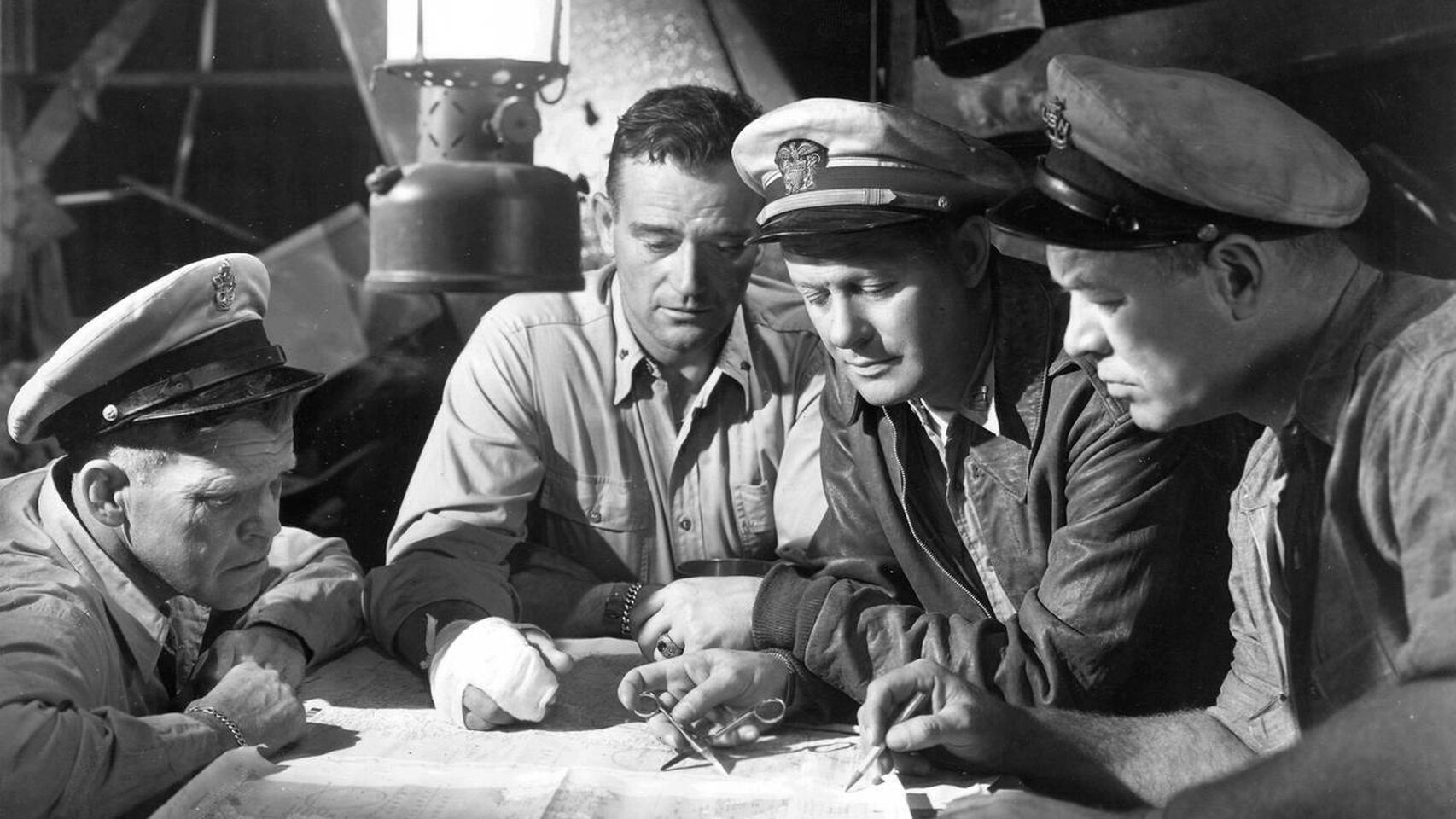
Another example of honor in defeat is Ford’s They Were Expendable (1945). It’s based on the true story of John Bulkeley, who helped develop the PT boat for naval combat in World War II. The backdrop is the attack on Pearl Harbor and the bravery of the American forces in what was their worst military defeat up until that time. Robert Montgomery plays Lt. John Brickley (changed from “Bulkeley” for the film), John Wayne plays Lt. Rusty Ryan (Brickley’s friend), and Donna Reed plays Lt. Sandy Davis (the love interest). As in all of Ford’s films, the characters are never lost in the sweep of history. The characterizations are strengthened through the accumulation of personal details — a subtle gesture, a casual look, or an act of kindness that forges a bond between two characters.

They Were Expendable is one of my favorite World War II films. Another is Air Force (1943), directed by Howard Hawks. Apart from having a similar plot (the attempt to recover militarily after an initial defeat in the Pacific), both films are top-notch character studies. They’re also seeped in the feel-good (even propagandistic) wartime ethos that urges us to set aside our differences and join together to overcome a common enemy.

Here’s an interesting bit of trivia. Ward Bond was injured in an automobile accident just before production began on this film. To explain the crutches Bond needed to move around, Ford added a scene in which Bond’s character is wounded.

They Were Expendable
(1945; directed by John Ford)
Warner Archive Collection (Blu-ray)
Warner Home Video (DVD)

Tuesday, November 11 at 7:00 a.m. eastern on Turner Classic Movies