She’s Alive!

She’s Alive!

Reviews

A rare instance where the sequel is even better than the original, Bride of Frankenstein picks up where Frankenstein left off. It’s one of the best classic horror movies ever made. There were two problems for director James Whale in filming the sequel. The angry peasants had killed the monster in the previous film, and the public had begun to identify the monster as Frankenstein, rather than as Dr. Frankenstein’s monster.

This time, the film begins with a historical conceit. Dainty and demure Mary Shelley has surprised her husband Percy Shelley and friend Lord Byron — two of the great Romantic-era poets — with the horror and violence of her story:

Byron: Look at her Shelley. Can you believe that bland and lovely brow conceived of Frankenstein, a Monster created from cadavers out of rifled graves? Isn’t it astonishing?
Mary: I don’t know why you should think so. What do you expect? Such an audience needs something stronger than a pretty little love story. So why shouldn’t I write of monsters?
Byron: No wonder Murray’s refused to publish the book. He says his reading public would be too shocked.
Mary: It will be published, I think.
Percy: Then, darling, you will have much to answer for.

Elsa Lanchester portrays Mary Shelley (credited), as well as the Bride (uncredited). Boris Karloff returns as the Monster and is billed simply as KARLOFF above the film’s title. The cast includes a spirited performance by Ernest Thesiger as Dr. Pretorius, a mad scientist who miniaturizes people and imprisons them in glass jars. The script, sets, and movements of the characters were heavily influenced by the German Expressionist films of the 1920s. The Bride’s first robot-like gestures recall Maria’s gestures when she was brought to life as a robot in Fritz Lang’s Metropolis.

Bride of Frankenstein
(1935; directed by James Whale)
Universal Studios (Blu-ray and DVD)

Sunday, September 7 at 8:00 p.m. eastern on Turner Classic Movies

No Man’s Land

No Man’s Land

Reviews

Though the two films are worlds part, Paths of Glory (1957) has a lot in common with Dr. Strangelove (1964). Both were directed by Stanley Kubrick, both are hard-hitting anti-war films, and both attack the folly of those who send others off to die. Yet Paths of Glory is the stronger anti-war film. Where Strangelove is played for laughs, this one is deadly serious.

Based on Humphrey Cobb’s controversial 1935 novel, it was turned down by every major studio in Hollywood. Kubrick was just 28 years old when he offered the leading role to Kirk Douglas, who was already an established star. In his autobiography The Ragman’s Son, Douglas wrote that he said to Kubrick, “Stanley, I don’t think this picture will ever make a nickel, but we have to make it.” Douglas had recently signed with United Artists to star in The Vikings (1958). He used his influence to convince the studio to finance the film, which was produced by Douglas’ own company, Bryna Productions.

Douglas was correct. Paths of Glory didn’t turn a profit during its initial release. Fearing it might not be received well in Europe, Kubrick asked composer Gerald Fried to create two title themes for the film. The first was based on the French national anthem, the “Marseillaise.” Because the film is sharply critical of the French military authorities, a second theme that didn’t use the national anthem was used for France and several other European countries. Despite the attempt to soften the blow, Paths of Glory was banned in France until 1975.

Don’t be put off by the fact that Kubrick was 28 years old when he directed the film. This is one of his best, and it’s no less intelligent or less polished than his later, more celebrated films. Kubrick was an obsessive perfectionist — even then. For example, he shot 68 takes of the scene where the soldiers are offered a last meal. They were supposed to be eating during the scene, so a new roast duck had to be prepared for almost every one of the takes.

Paths of Glory
(1957; directed by Stanley Kubrick)
The Criterion Collection (Blu-ray and DVD)

Saturday, August 30 at 2:00 p.m. eastern on Turner Classic Movies

Greatest Hollywood Musical

Greatest Hollywood Musical

Reviews

Is there anyone into classic films who doesn’t like Singin’ in the Rain (1952)? Given that 19-year-old Debbie Reynolds had never danced before, and the script had to be written around a group of songs with little in common, it’s a wonder (and a tribute to those involved) that this would turn out to be the greatest Hollywood musical.

Reynolds received six months of intensive dance training before the production began. She had already shown her singing ability and plucky appeal in her previous films (most notably in Two Weeks with Love, where she sang “Abba Dabba Honeymoon” with Carleton Carpenter).

Famed creative team Betty Comden and Adolph Green were given the near impossible task of crafting a storyline around a diverse selection of tunes from the 1920s and 1930s. Two songs, “Fit as a Fiddle” and “Moses Supposes,” were new to this production. “Make ‘Em Laugh” was adapted from Cole Porter’s “Be a Clown,” which Gene Kelly performed in The Pirate (1948). The others were part of a catalogue of songs, acquired by MGM, that had been written by Arthur Freed and Nacio Herb Brown.

Singin’ in the Rain is filled with references to other films. The story centers around the period from 1927 through 1929 when the industry transitioned from silent films to “talkies.” There are allusions to particular films from that period. For example, the fictional film the characters are producing (titled The Dueling Cavalier) is based on an actual film, titled The Cavalier (1928). Like its fictional counterpart, it began as a silent film but was hastily transformed into a sound film, largely through the addition of poorly dubbed musical numbers. And in the Hollywood premiere sequence, the character Zelda Zanders, known as the “Zip Girl,” is meant to evoke the real-life Clara Bow, known as the “It Girl.”

Just as they borrowed songs and plot devices from earlier movies, co-directors Stanley Donen and Gene Kelly scavenged the back lot for suitable props from previous MGM movies. Debbie Reynolds’ car is Andy’s old jalopy from the Andy Hardy series. And the mansion where Gene Kelly lives is decorated with furniture and fixtures from Flesh and the Devil (1926).

The movie references extend to the musical numbers and film-within-a-film scenes. The “Gotta Dance” number echoes previous MGM musicals, including Words and Music (1948), The Pirate, Summer Stock (1950), and An American in Paris (1951). Gene Kelly’s musketeer movie at the beginning of the story recalls his earlier film, The Three Musketeers. And when Kelly brings Reynolds onto an empty sound stage and turns on the lights, it mimics his earlier film, Summer Stock.

While the movie references are fun for film buffs, the real joy comes from the memorable songs, exuberant dance numbers, and snappy dialogue. If you haven’t seen it, you’ll be amazed to find how good a movie musical can be. Even if you don’t like movie musicals, you’ll probably like this one. Nothing else comes close.

Singin’ in the Rain
(1952; directed by Stanley Donen and Gene Kelly)
Warner Home Video (Blu-ray and DVD)

Thursday, August 28 at 8:00 p.m. eastern on Turner Classic Movies

A Madcap Ride

A Madcap Ride

Reviews

Can one film save a failing movie studio? If the film is It Happened One Night (1934), it can. Columbia Pictures needed a hit in order to survive, and it was a gamble for the studio to spend $325,000 on this project, especially since several bus-related movies had recently failed at the box office. Fortunately, everything clicked, and It Happened One Night became the sleeper hit of 1934. It went on to become the first film to sweep all five major Academy Awards: Best Picture, Best Director, Best Actor, Best Actress, and Best Screenplay. Yet immediately after she had completed filming her scenes, Claudette Colbert had told her friends, “I’ve just finished the worst picture in the world.”

If you know director Frank Capra’s later comedies, such as Mr. Deeds Goes to Town (1936), Mr. Smith Goes to Washington (1939), and It’s a Wonderful Life (1946), you may be surprised by the restrained sentimentality in this one. Part of what makes this comedy so enduring is its in-your-face banter that doesn’t take itself too seriously. Robert Riskin wrote the screenplay, based on the short story “Night Bus” by Samuel Hopkins Adams. The script moves at a quick pace, and its self-deprecating humor resonated with depression-era audiences who were trying to cope with financial pressures.

Here’s a scene between Peter Warne (played by Clark Gable) and Alexander Andrews (played by Walter Connolly):

Alexander Andrews: Oh, er, do you mind if I ask you a question, frankly? Do you love my daughter?
Peter Warne: Any guy that’d fall in love with your daughter ought to have his head examined.
Alexander Andrews: Now that’s an evasion!
Peter Warne: She picked herself a perfect running mate – King Westley – the pill of the century! What she needs is a guy that’d take a sock at her once a day, whether it’s coming to her or not. If you had half the brains you’re supposed to have, you’d done it yourself, long ago.
Alexander Andrews: Do you love her?
Peter Warne: A normal human being couldn’t live under the same roof with her without going nutty! She’s my idea of nothing!
Alexander Andrews: I asked you a simple question! Do you love her?
Peter Warne: YES! But don’t hold that against me, I’m a little screwy myself!

Some film historians cite It Happened One Night as the first screwball comedy. Whether that’s the case depends on how you define a screwball comedy. It opened earlier in the year than Twentieth Century (1934) and The Merry Widow (1934), yet it was released one year after Duck Soup (1933) and two years after Trouble in Paradise (1932). It’s certainly one of the first screwball comedies and easily one of the best.

It Happened One Night
(1934; directed by Frank Capra)
The Criterion Collection (Blu-ray)
Sony Pictures (DVD)

Sunday, August 10 at 12:00 p.m. eastern on Turner Classic Movies

Beyond Intellect

Beyond Intellect

Reviews

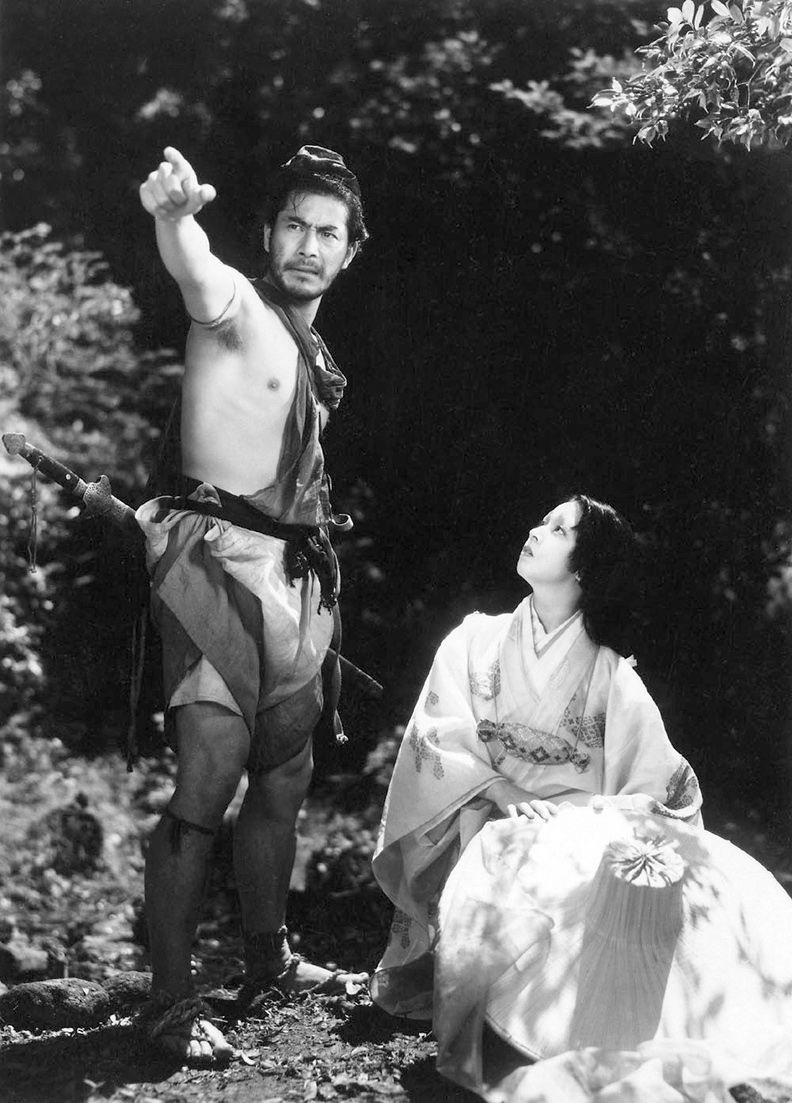
Many of today’s teenagers have never seen a classic foreign film. So what would be the best one to show a teenager if you wanted to pique his or her interest in foreign films? The best choice might be Seven Samurai (1954). Because Kurosawa was so strongly influenced by Hollywood films (especially the Western genre), Seven Samurai’s moral contrasts are immediately familiar. At the same time, this film is unmistakably Japanese in its approach.

Here’s what Japanese-film historian Donald Richie had to say in his seminal book Japanese Cinema:

In many ways, Seven Samurai is both the opposite and the continuation of Rashomon. The earlier film represents the limitations of the intellect: four stories, each completely intellectualized, all mutually incompatible, and all, in their way, ‘true.’ Seven Samurai on the other hand, steps beyond intellectualization. It says that only those acts which spring from emotion are valid acts; that action thus motivated is itself truth. This truth is one which remains, though universally applicable, particularly Japanese. It is one which is shared with Zen and with the haiku, as well as the films of Ozu and Kurosawa — the emotions comprehend where the intellect falters. The basic dichotomy is one recognized and insisted upon in Japan just as much as in the West, and Kurosawa’s humanism, his Dostoevsky-like compassion, remains his final and strongest statement.

Like Ford and Renoir, Kurosawa was able to portray his characters compassionately without resorting to clichés or overt sentimentality. At its core, Seven Samurai is an action film that abhors violence, a film about cooperation that celebrates individuality, and a film about the world’s heartlessness that encourages simple kindness.

Few films succeed so grandly both as visceral entertainment and as an artful commentary on the human condition. Both elements are bound together so seamlessly, it’s impossible to tell where one ends and the other begins. That may be the truest measure of the most successful films and novels — that we can be simultaneously entertained and enriched as though there was no difference at all between the two qualities.

Seven Samurai
(1954; directed by Akira Kurosawa)
The Criterion Collection (Blu-ray and DVD)

Tuesday, June 8 at 12:00 p.m. eastern (late Mon. night) on Turner Classic Movies
The Forgotten Man

The Forgotten Man

Reviews

While the screwball comedy is a byproduct of the Great Depression, not every screwball comedy reflects the era head-on. My Man Godfrey (1936) is both a spoof of — and a commentary on — the financial inequities at the time. The movie-going public was well aware the Depression was hitting the poor much harder than the wealthy, so poking fun at the idle rich was a staple of the genre. The prevailing attitude? We’re all in this together, so don’t get snooty or high-hat just because you’re well off.

Unlike the previous year’s Ruggles of Red Gap, where a real butler finds himself in the wild west, My Man Godfrey’s butler may not be what he appears to be. Both films poke fun at rich Americans who have plenty of dollars, but no sense. Godfrey is more direct in its satire, and like Sullivan’s Travels (1941), its message for social equality (in the midst of economic inequality) is front and center.

William Powell is perfectly cast as Godfrey the butler, who knows more about money and manners than his employers (echoing Charles Laughton’s role in Ruggles of Red Gap). Carole Lombard plays Irene, a spoiled heiress who is bored with her frivolous life — though she doesn’t know it yet. Here’s an example of the interplay between Powell and Lombard:

Godfrey: Do you mind telling me just what a scavenger hunt is?
Irene: Well, a scavenger hunt is exactly like a treasure hunt, except in a treasure hunt you try to find something you want, and in a scavenger hunt you try to find something that nobody wants.
Godfrey: Hmm, like a forgotten man?
Irene: That’s right, and the one who wins gets a prize, only there really isn’t a prize. It’s just the honor of winning, because all the money goes to charity, that is, if there is any money left over, but there never is.
Godfrey: Well, that clears the whole matter up beautifully.

This was the first film to be nominated for all four acting Oscars: Best Actor, Best Actress, Best Supporting Actor, and Best Supporting Actress. Coincidentally, it was the very first year for the two supporting awards. My Man Godfrey was also nominated for the writing and directing Oscars. To this day, it’s the only film to be nominated for all six awards and not be nominated for Best Picture. And to this day, it’s the only film to be nominated for all six awards and not win any of them.

My Man Godfrey
(1936; directed by Gregory La Cava)
The Criterion Collection (Blu-ray and DVD)

Sunday, July 6 at 12:00 p.m. eastern on Turner Classic Movies

Crowd Control

Crowd Control

Reviews

Fritz Lang’s first American film after fleeing the Hitler regime in Germany, Fury (1936) is a terrifying look at how good people can go bad when swayed by the darker instincts of a crowd. The incredible scenes where the mob tries to lynch an innocent man recall the workers frantically fleeing the city in Metropolis and the angry calls for justice against the child murderer in M.

David O. Selznick brought Lang to MGM in 1934. He languished at the studio for months and was nearly fired. Given one last chance, Lang was handed a four-page outline titled Mob Rule. MGM told Lang and writer Barlett Cormack they would need to develop it into a script for Lang to direct.

Lang didn’t speak English very well at the time, so he looked around for inspiration. He found that inspiration in the form of newspaper clippings, as he explains in a 1965 interview with Peter Bogdanovich:

I followed a habit I had in Europe (and still have) of collecting newspaper clippings — I have used them for a lot of my pictures. We found a lynching case that had happened in San Jose, California, a few years before I made the film, and we used many newspaper clippings for the script.

Spencer Tracy turns in a gripping performance as Joe Wheeler, a man jailed for a crime he didn’t commit. Sylvia Sidney portrays his loyal girlfriend. The film also provides early roles for long-time character actors Walter Brennan and Ward Bond.

While it would be easy to dismiss Fury as a transitional film where Lang is learning how to deal with the restrictions of the Hollywood studio system, I find it has an unusual rawness and intensity. Lang must have seen something in it. Fury was his favorite film among the ones he directed in the U.S.

Fury
(1936; directed by Fritz Lang)
Warner Home Video (DVD)

Saturday, July 5 at 6:00 a.m. eastern on Turner Classic Movies

Born on the 4th of July

Born on the 4th of July

Reviews

Many people are surprised that James Cagney’s only Oscar was for his role in Yankee Doodle Dandy (1942). One reason is that the Academy doesn’t tend to reward performances in genre films, such as gangster, adventure, or science fiction films. It also doesn’t tend to reward performances in musicals, though Yankee Doodle Dandy was an exception.

If you think of Cagney’s roles in the gangster movies, it was his confidence that won you over. Only 5 feet 6 inches tall (short by Hollywood standards), Cagney could stare down anyone in the room. It’s just that kind of brash confidence that made him the perfect choice to portray George M. Cohan, who was just as cocky and full-of-himself in real life as Cagney was onscreen. Cagney also had the background needed to play the part. He started in Hollywood as a song-and-dance man, but was sidetracked into gangster movies when asked to switch parts at the last minute.

Cagney did get a chance to return to his song-and-dance roots with his role in Footlight Parade (1933). There, as in Yankee Doodle Dandy, he doesn’t come off as a polished singer or dancer. It’s his enthusiasm that wins you over. He becomes a terrific dancer almost be sheer will alone. If you’ve ever been told, “it’s not what you have; it’s what you do with it,” you’ll find all the proof you need in Cagney’s performance in Yankee Doodle Dandy

Of course, it takes more than a single strong performance to make a great film — particularly if that film happens to be a musical. Cohan’s deeply patriotic songs are real crowd pleasers, not just for their sentiment, but also because they’re the kind of songs that linger in the mind long after you first hear them. Though written for World War I era audiences, they were equally appropriate in 1942 when this movie was released — just months after Pearl Harbor. Even from our perspective, the songs and sentiment still ring true. Odds are you already know many of the songs from the film, which include “The Yankee Doodle Boy” (a.k.a. Yankee Doodle Dandy), “Give My Regards to Broadway,” “You’re a Grand Old Flag,” “Harrigan,” “Mary’s a Grand Old Name,” and “Over There.”

A heartfelt movie biography could easily fall on its face without a strong script. Credit here goes to Robert Buckner and Edmund Joseph, who adapted the screenplay from Buckner’s story. Director Michael Curtiz, whose Casablanca was released the same year, keeps the pace brisk with plenty of humor to take off the edge. Here are some snippets of dialogue:

Critic #1: I call it a hit. What’ll your review say?
Critic #2: I like it too, so I guess I’ll pan it.

George M. Cohan: My mother thanks you, my father thanks you, my sister thanks you, and I thank you.

Newspaperman: He’s the whole darned country squeezed into one pair of pants!

Sergeant on parade: What’s the matter, old timer? Don’t you remember this song?
George M. Cohan: Seems to me I do.
Sergeant on parade: Well, I don’t hear anything.

Michael Curtiz was perhaps Hollywood’s hardest working director in the 1930s and 1940s. He turned out an impressive 44 features for Warner Bros. from 1930 through 1939. Curtiz had an extraordinary range across a diverse group of genres. In addition to Yankee Doodle Dandy and Casablanca, he directed Black Fury (1935), Captain Blood (1935), The Charge of the Light Brigade (1936), The Adventures of Robin Hood (1938), Four Daughters (1938), Angels with Dirty Faces (1938), The Sea Hawk (1940), The Sea Wolf (1941), Mildred Pierce (1945), Life with Father (1947), and The Breaking Point (1950).

The new Blu-ray disc released on October 14 looks great — and it’s a big improvement over the previous DVD versions. The generous selection of extras is essentially the same as on the two-disc special edition DVD. Unfortunately, the extras are ported directly over in the same standard-definition video (480i). The exception is the 1943 Looney Tunes cartoon short Yankee Doodle Daffy. Like the movie, it has been upgraded to a very nice 1080p video. This Blu-ray is an excellent way to experience this top-notch musical drama.

Yankee Doodle Dandy
(1942; directed by Michael Curtiz)
Warner Archive Collection (Blu-ray)
Warner Home Video (DVD)

Friday, July 4 at 8:00 p.m. eastern on Turner Classic Movies

Double Trouble

Double Trouble

Reviews

The best film noir centers on fate. Characters are destined to commit a crime because they can’t escape their past. Or a fatal flaw keeps them from seeing the obvious truth, so the tension builds as we’re unable to warn the characters, as we might be able to do in real life.

Double Indemnity (1944) is almost a textbook film noir. The voice over and flashbacks reinforce the inevitability of the outcome. We already know Walter Neff (played by Fred MacMurray) has committed a crime, has been shot, and will likely be caught. As we watch the flashbacks, we accept the inevitable outcome, knowing nothing can prevent him from being used by Phyllis Dietrichson (played by Barbara Stanwyck).

With the whodunit out of the way, we can sit back and enjoy the unfolding story. Walter’s self assurance and mocking humor are seen for what they are — a cover for a weak character that’s no match for Phyllis’ cunning manipulation.

Double Indemnity was only the third film that Billy Wilder had directed, though he had already made his mark in Hollywood as a writer for such classic films as Midnight (1939), Ninotchka (1939), Hold Back the Dawn (1941), and Ball of Fire (1941).

The movie is based on a James M. Cain story which first appeared in 1935 in Liberty Magazine. Cain was not available to work on the screenplay, so Wilder called in novelist Raymond Chandler, who is best known today for creating the character of private detective Philip Marlowe.

Chandler had a great ear for dialogue. He also knew how to successfully extend a metaphor far beyond what anyone thought was humanly possible. Wilder knew how to take a complicated plot and make it completely understandable when transferred to the screen. He was also a master of restrained cynicism. Together they wrote one of the best scripts of the 1940s.

Here’s a small sample:

Phyllis: Mr. Neff, why don’t you drop by tomorrow evening about eight-thirty. He’ll be in then.
Walter: Who?
Phyllis: My husband. You were anxious to talk to him weren’t you?
Walter: Sure, only I’m getting over it a little. If you know what I mean.
Phyllis: There’s a speed limit in this state, Mr. Neff. Forty-five miles an hour.
Walter: How fast was I going, officer?
Phyllis: I’d say about ninety.
Walter: Suppose you get down off your motorcycle and give me a ticket.
Phyllis: Suppose I let you off with a warning this time.
Walter: Suppose it doesn’t take.
Phyllis: Suppose I have to whack you over the knuckles.
Walter: Suppose I bust out crying and put my head on your shoulder.
Phyllis: Suppose you try putting it on my husband’s shoulder.
Walter: That tears it.

With Double Indemnity, everything works together in lockstep — the script, the direction, the acting, the lighting, everything. Elements from this movie are copied and adapted every decade, as new directors strive to rekindle the magic. None have surpassed it. And why bother? When we have the original to enjoy and cherish.

Double Indemnity
(1944; directed by Billy Wilder)
Universal Studios (Blu-ray and DVD)

Saturday, June 28 at 8:00 p.m. eastern on Turner Classic Movies

A Cut Above

A Cut Above

Reviews

Mention the topic of foreign films to some people, and you may elicit a wince or frown. They think of hard-to-decipher films such as Bergman’s Persona (1966), austere films such as Dreyer’s Gertrud (1964), or confrontational films such as Fellini’s Satyricon (1969). Add in the difficulty of reading the subtitles, and you don’t have to travel far to find film fans who avoid anything foreign.

Fortunately, there are many foreign language films that are eminently approachable. They’re warm, upbeat, and easily digested. And truth be told, the approachable ones are often as good as the more demanding ones. In my opinion, Fellini’s Amarcord (1973) is as fine as (1963). But why choose between them, when you can savor both?

This brings us to Cinema Paradiso (1989). You would have to be hardhearted not to be touched emotionally by this film, yet it’s much more than a warmhearted story. It’s nostalgic not just for a way of life that had disappeared, but also for a style of filmmaking that had grown out-of-style. Ennio Morricone’s excellent musical score intensifies the experience, as it strikes the right mood in just the right places. Not surprisingly, Cinema Paradiso won the 1990 Oscar for Best Foreign Language Film.

As good as the 124-minute theatrical release is, the 174-minute re-edited version is even better. You’ll have to rent or purchase the DVD to see the longer cut, which is more complete than the original 155-minute Italian release of the film. While all three versions are centered on the relationship between a young fatherless boy and a solitary movie projectionist, the newer version spends more time with the boy as an adult as he searches for Elena, his lost love.

Given the 124-minute running time listed on the TCM website, it looks like HTCM will be showing the theatrical version. Don’t worry about not seeing the longer version first, as the theatrical version stands up well on its own.

Cinema Paradiso
(1989; directed by Giuseppe Tornatore)
Miramax (Blu-ray and DVD)

Thursday, June 5 at 8:00 p.m. eastern on Turner Classic Movies