Eerie Dislocation

Eerie Dislocation

Reviews

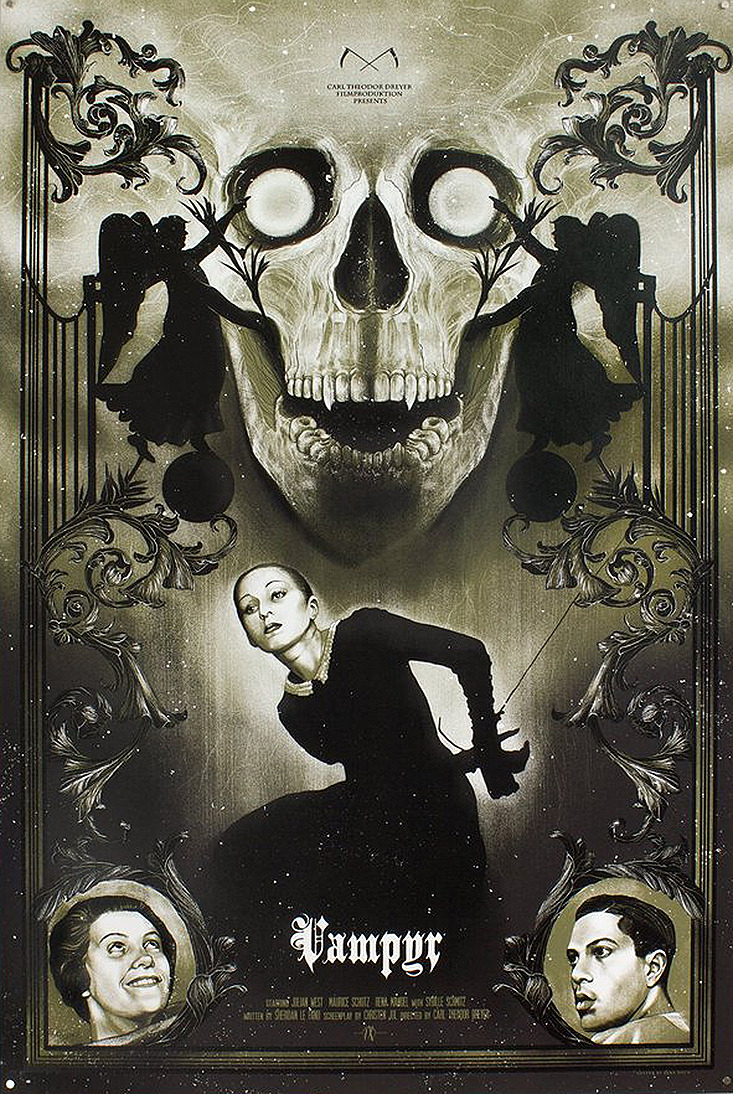
A typical horror movie has few surprises, so it isn’t very horrifying. A truly frightening movie would have to throw you off-kilter, so you don’t have a chance to relax or become too comfortable with the made-up world. That’s what Carl Dryer’s Vampyr (1932) does. To intensify the sense of foreboding, it continually shifts the ground out from under your feet. It may be the most unusual horror film you’ll ever see.

According to The Cinema of Carl Dryer by Tom Milne, Dryer described his stylistic approach to his crew with these words:

Imagine that we are sitting in an ordinary room. Suddenly we are told that there is a corpse behind the door. In an instant the room we are sitting in is completely altered; everything in it has taken on another look; the light, the atmosphere have changed, though they are physically the same. This is because we have changed and the objects are as we conceive them. That is the effect I want to get in my film.

Released a year after Tod Browning’s Dracula (1931) starring Bela Lugosi, Vampyr’s vampire isn’t identified until late in the story. Yet Dryer conveys the vampire’s influence right from the beginning using a variety of disorienting cinematic techniques. These techniques include seeing the effect of an action well before its cause, especially through Allan Grey’s (the main character’s) dreams and visions. Dryer often moves the camera independently of the action as though it anticipates something the characters are only vaguely aware of. Similarly, the point of view sometimes shifts oddly. For example, at the beginning of the story, we bounce back and forth between interior and exterior views of the inn. That suggests Grey’s perspective may be too limited to comprehend all that will transpire.

At first glance, these techniques might seem random or amateurish. They are, in fact, quite deliberate. They’re designed to make us question what we see on the screen, just as Grey will need to question the reality around him in order to uncover the evil that has taken hold there. As a counter balance, Dryer uses explanatory intertitles and quotes from Grey’s book on vampires to center the story.

The result is a journey through a supernatural world defined by its own logic and rules that are revealed only as the story progresses. While not entirely successful, Vampyr would be my pick for the most ambitious horror film ever made. It creates both an eerie atmosphere and a parallel sense of psychological dislocation.

Keep in mind that Vampyr was the film Dryer chose to direct following The Passion of Joan of Arc (1928). In both films, the main character is challenged to stand by a set of beliefs that can’t be proved.

Vampyr
(1932; directed by Carl Dryer)
The Criterion Collection (Blu-ray and DVD)

Saturday, November 1 at 7:00 a.m. eastern on Turner Classic Movies

One of Us

One of Us

Reviews

One of the more unusual Hollywood studio films from the 1930s is Tod Browning’s Freaks (1932). It’s often dismissed as an exploitation film or a cheap attempt at sensationalism. In fact, it’s neither. Browning, best known for having directed Dracula the year before, had run away to join the circus when he was 16 years old. He worked as a talker (popularly, though incorrectly, known as a circus “barker”). He also worked as “The Living Corpse” and performed as a clown with Ringling Brothers.

Browning chose real-life circus freaks for many of the roles in the film, not so much to exploit or sensationalize their presence, but to portray them as he had experienced them — as ordinary people with mostly ordinary lives. By contrast, the other characters in the film are portrayed as greedy, arrogant, and intolerant. They’re the real freaks. From this point of view, Freaks is the opposite of an exploitation film. Andrew Sarris has argued it’s “one of the most compassionate films ever made.”

As entertainment, Freaks has its ups and downs. The circus freaks aren’t always convincing. They’re amateur actors, after all. Unfortunately, some of the professional actors aren’t much better. Former silent star Olga Baclanova has a heavy Russian accent that tends to get in the way.

On the plus side is Browning’s skill in weaving suspense and horror elements into the narrative. He does this without undercutting his central thesis that the freaks are better adjusted and more tightly bonded in friendship than the outsiders. As a former circus talker, Browning knows audiences want to stare at the freaks, even as they want to turn away in disgust. He uses these contradictory emotions to build to an exciting finish. A scene where the freaks sincerely accept an outsider as “one of us” evokes similar mixed emotions, both for the character in the film and vicariously for the audience.

This film isn’t for everyone. If you can move beyond the sub-par acting and shock-horror overlay, you’ll find a serious exploration of what it means to be a kind and generous person, no matter which cards life has dealt for you.

Freaks
(1932; directed by Tod Browning)
Warner Home Video (DVD)

Thursday, October 30 at 11:45 a.m. eastern on Turner Classic Movies

No Fighting in the War Room

No Fighting in the War Room

Reviews

It’s hard to write about Stanley Kubrick’s Dr. Strangelove or: How I Learned to Stop Worrying and Love the Bomb (1964) without resorting to superlatives. It’s the best comedy of the 1960s. It’s the best black comedy ever. It has the longest title of any Oscar-nominated film. Just as Kubrick’s 2001: A Space Odyssey (1968) redefined optimism about the future possibilities of technology, Dr. Strangelove redefined pessimism about the current limitations of technology. In both films, technology is seen as an extension of human nature.

Kubrick started out to make a thriller about an accidental nuclear attack. But as he adapted Peter George’s novel Red Alert for the screen, he saw the comic potential in many of the scenes. He brought in Terry Southern to help turn the project into a dark satire bordering on farce. Kubrick and Southern conceived a very different ending. The story was to conclude with a giant food fight in the war room (look for a large food table in the background near the end of the movie). The characters would have thrown pies at each other in a visual reductio ad absurdum (Latin for “reduction to the absurd”). Kubrick went so far as to actually shoot that ending, though only stills from it survive today.

Peter Sellers plays three parts in the movie: Group Captain Lionel Mandrake, President Merkin Muffley, and Dr. Strangelove. Sellers was originally slated to play a fourth part, that of Major T. J. ‘King’ Kong. Kubrick wanted to show the same personality was present at every stage of the process, from the President ordering a bombing to an airman personally delivering the bomb. Sellers was finding it hard to get the Texas accent right for the Major, so when he broke his leg about the same time, Kubrick decided to cast Slim Pickens for the role.

Kubrick had planned to premiere the film in December 1963, but delayed the opening because of the November 22 assassination of President Kennedy. Following his list of the contents in the survival pack, Major Kong says, “a fella could have a pretty good weekend in Vegas with all that stuff.” Pickens had originally mentioned “Dallas” as the city, but Kubrick had him dub in “Vegas” so as not to remind the audience of the assassination.

(Criterion’s Blu-ray edition includes the documentary No Fighting in the War Room, as one of the supplements.)

Dr. Strangelove or: How I Learned to Stop Worrying and Love the Bomb
(1964; directed by Stanley Kubrick)
The Criterion Collection (Blu-ray and DVD

Saturday, October 25 at 6:15 p.m. eastern on Turner Classic Movies

Emotionally Satisfying

Emotionally Satisfying

Reviews

No matter how many classic films you’ve seen, there will always be films that escape your notice. They may no longer exist (most silent films, for example). There may be rights issues (the long version of Abel Gance’s Napoleon, for example). Or you didn’t know enough about them to actively seek them out (hence this site’s tagline: so many movies, so little time).

I hadn’t seen Random Harvest (1942) until about ten years ago. I had forgotten what a competent director Mervyn LeRoy was and had neglected to look for his other films. Admittedly, his output is uneven, but any director responsible for the likes of Little Caesar (1930), I Am a Fugitive from a Chain Gang (1932), Hard to Handle (1933), They Won’t Forget (1937), Waterloo Bridge (1940), and Mister Roberts (1955; co-directed with John Ford) is worth further study.

As a sentimental romantic drama, Random Harvest is surprisingly restrained. This is a film that tugs on the heartstrings without treating the audience as though it has a collective IQ of 50. The various twists and turns are laid out carefully, and even when you know where it’s heading, the movie remains intellectually and emotionally satisfying. The plotline is important, so do refrain from reading too much about this one until you’ve had a chance to see it. Above all, don’t read the back of the DVD case, which gives away half the plot (what were they thinking?). The story is based on the novel by James Hilton, who is best known as the original author of two other Hollywood adaptations: Lost Horizon (1937) and Goodbye, Mr. Chips (1939). That these three creatively successful films were directed by three different directors speaks well of the narrative strength of the novels.

The casting of the two leads is another plus. Ronald Colman and Greer Garson were highly regarded by their contemporary audiences. Today, they’re barely known by the general public. If you’ve ever wondered just how talented Colman and Garson were, this film should answer that question in spades. Bottom line: If you tend to avoid sentimental Hollywood dramas, give this one a chance. The performances, script, and direction place it firmly in the don’t-miss category.

Random Harvest
(1942; directed by Mervyn LeRoy)
Warner Home Video (DVD)

Sunday, October 19 at 11:45 a.m. eastern on Turner Classic Movies

Inner Paralysis

Inner Paralysis

Reviews

Just as Hitchcock learned how to distill suspense into its purist form, so Luis Buñuel learned how to distill surrealism into its purist form. His best films often have the slimmest of plots. On the surface, The Discreet Charm of the Bourgeoisie (1972) is about a group of people who try to eat a meal together but are always interrupted. At first glance, The Milky Way (1969) is the story of two pilgrims who encounter historical heresies along their journey.

The Exterminating Angel (1962) is another wonderfully complex Buñuel film that’s spun from a deceptively simple idea. A group of society friends gather at the home of an aristocrat. As the evening progresses, the servants feel compelled to leave, while the guests feel compelled to stay. If you’ve ever wondered what happens when house guests refuse to leave, this film will illustrate that nightmare. Why can’t they leave? Could they leave if they really wanted to? These are the kinds of questions that flow from this powerful plot device.

There has been a fair amount of speculation about the title of this film. Is Buñuel using a poetic phrase with no direct connection in order to provide an associative lift? Or is there a deeper, more subtle meaning (always a possibility with Buñuel)? Here’s what Raymond Durgnat had to say about the matter in his book Luis Bunuel:

The ‘angel’ is the spiritual climate of bourgeois conformism, drawn to its (desired) conclusion of inner paralysis. The prisoners are trapped in their social roles. Faced with the inexplicable, their rationality decomposes into fetishist fixations. The violence to which they resort is no liberation, has no quality of defiance, and in that respect is totally opposed to the convulsive sadism in L’Age d’Or.

This movie can be enjoyed on many levels. You can watch it as a kind of Twilight Zone episode that sets up a hypothetical premise and unfolds the consequences. You can approach it as social commentary and be amply rewarded with insight into how our lives are outwardly swayed by social, religious, and political influences. Or you can view the story through a psychological prism that reveals the inner turmoil and confusion that grows out of our innate desire to be accepted by others.

And if you think that’s multi-layered, wait until you experience the tone of the film, which cycles from drama to comedy to satire to the grotesque. Sometime all four qualities appear to be operating simultaneously. Sometime two qualities co-exist with one seeming to comment on the other. The complexity is there if you want to experience it, but can be ignored if you just want to settle into a good yarn. That’s what makes Buñuel such an intriguing filmmaker.

The Exterminating Angel
(1962; directed by Luis Buñuel)
The Criterion Collection (Blu-ray and DVD)

Wednesday, September 24 at 5:00 a.m. eastern on Turner Classic Movies

Golden Treasure

Golden Treasure

Reviews

Greed and human nature — it’s a common theme in both movies and literature, but rarely has it been handled as expertly as in The Treasure of the Sierra Madre (1948).

Following his service in World War II, director John Huston found the ideal project for his next film. It would be based on the novel The Treasure of the Sierra Madre, written by the mysterious B. Traven. Even today, no one is quite sure who B. Traven was, though historians strongly suspected that Traven met with Huston under an assumed name during the film’s production in Mexico.

The movie is a carefully crafted moral tale about human frailty and the difficulties we might encounter when given the chance to accumulate massive wealth. The three main characters react differently, and it’s the difference in their reactions that keeps the tale from becoming too dark and cynical.

Huston wrote the screenplay, and he keeps a tight rein on the narrative as the story and characters progress to a satisfying conclusion.

Here are a few gems from the film’s dialogue:

Flophouse Bum: $5,000 is a lot of money.
Howard: Yeah, here in this joint it seems like a lot. But I tell you, if you was to make a real strike, you couldn’t be dragged away. Not even the threat of miserable death would keep you from trying to add 10,000 more. Ten, you’d want to get twenty-five; twenty-five you’d want to get fifty; fifty, a hundred. Like roulette. One more turn, you know. Always one more.

Gold Hat: We are Federales… you know, the mounted police.
Dobbs: If you’re the police, where are your badges?
Gold Hat: Badges? We ain’t got no badges. We don’t need no badges! I don’t have to show you any stinkin’ badges!

Howard: We’ve wounded this mountain. It’s our duty to close her wounds. It’s the least we can do to show our gratitude for all the wealth she’s given us. If you guys don’t want to help me, I’ll do it alone.
Curtin: You talk about that mountain like it was a real woman.
Dobbs: She’s been a lot better to me than any woman I ever knew. Keep your shirt on, old-timer. Sure, I’ll help ya.

Huston cast his father Walter Huston in the pivotal role of Howard, a seasoned old prospector who understands from experience what gold fever can do to an otherwise honest man.

Both father and son won Oscars for this film (Best Supporting Actor for Walter Huston, and Best Director, as well as Best Screenplay, for John Huston). It was the first time a father and son had received Academy Awards for the same movie.

The recently released Blu-ray version is a joy to behold, especially if you’re able to view it on a large screen. Watch for several uncredited cameos, including John Huston as the American who Dobbs keeps asking for a handout, Jack Holt (Tim Holt’s real-life actor father) as an flophouse bum, and a young Robert Blake as a Mexican boy who sells lottery tickets from the street.

Also on the Blu-ray disc are an informative 49-minute documentary on the making of the movie, a comprehensive 128-minute documentary on John Huston, and a selection of short subjects from 1948.

The Treasure of the Sierra Madre
(1948; directed by John Huston)
Warner Home Video (Blu-ray and DVD)

Saturday, September 13 at 8:00 p.m. eastern on Turner Classic Movies


Individuals, Not Stereotypes

Individuals, Not Stereotypes

Reviews

In the 1930s, just about everyone went to the movies. That didn’t mean every movie was targeted to the widest possible audience. In fact, many films were aimed at mature audiences seeking intelligent and restrained drama. Few films, however, dealt with the complexities of middle age and the day-to-day difficulties of maintaining a marriage.

Dodsworth (1936) is an unusually frank film about a couple who are growing apart amid concerns about growing older. Based on a 1929 novel by Sinclair Lewis, the story was adapted in 1934 by Sidney Howard into a popular Broadway play starring Walter Huston and Fay Bainter. Two years later, Howard teamed with director William Wyler to bring the story to film. Huston reprised his role as industrialist Sam Dodsworth and Ruth Chatterton replaced Bainter in the role of Fran Dodsworth, his wife. Mary Astor played the other woman, Mrs. Edith Cortright, though clichés about the other woman fall by the wayside as the movie progresses. Several minor parts were filled by actors who played the same roles on Broadway.

The movie version doesn’t feel like a staged play, even though there is plenty of dialogue. Here are some of the more memorable lines from the film:

Sam Dodsworth: Love has got to stop some place short of suicide.

Fran Dodsworth: Oh, you’re hopeless — you haven’t the mistiest notion of civilization.
Sam Dodsworth: Yeah, well maybe I don’t think so much of it, though. Maybe clean hospitals, concrete highways, and no soldiers along the Canadian border come near my idea of civilization.

Fran Dodsworth: Remember, I did make a home for you once, and I’ll do it again, only you’ve got to let me have my fling now! Because you’re simply rushing at old age, Sam, and I’m not ready for that yet.

Baroness Von Obersdorf: [to Fran] Have you thought how little happiness there can be for the old wife of a young husband?

Apart from the writing, much of the credit has to go to Walter Huston, in one of the best roles of his career, and to William Wyler, whose assured direction makes the characters’ progression feel like an entirely natural development. Dodsworth doesn’t come across as a message picture — you’re not beat over the head with gold-encrusted truths simplified to the point where a 10-year-old child could quote them verbatim. Instead, the audience steadily accumulates knowledge about the characters and their predicaments. By the end, the characters’ decisions make perfect sense based on who we know them to be as individuals, rather than as stereotypes.

Dodsworth
(1936; directed by William Wyler)
MGM (DVD)

Thursday, September 11 at 8:00 p.m. eastern on Turner Classic Movies

A Leap of Faith

A Leap of Faith

Reviews

If the measure of a classic film is its ability to withstand the erosions of time, 2001: A Space Odyssey (1968) would have to be regarded as the best science fiction film of all time. Though we have moved beyond it chronologically, its predictive value still seems valid.

The decades-old special effects also hold up well. By comparison, George Lukas felt the need to repeatedly update the special effects and storyline in Star Wars (1977), despite the fact it was released nine years later. Science fiction films are especially prone to becoming dated. Both Woman on the Moon (1929) and Things to Come (1936) boldly depict a future that now seems forever bound to a distant past.

One of the reasons 2001 endures is Kubrick’s obsession with getting it right. When there’s an explosion in space, you don’t hear the sound of the explosion. That’s less dramatic, but completely accurate — there’s no air in space to carry the sound. Kubrick and writer Arthur C. Clarke even poke fun at their quest for authenticity. One scene shows the lengthy instructions needed to successfully operate a zero-gravity toilet.

Kubrick did find a technical flaw just before the film was released. It would have been too costly to correct, so the mistake remains. During the flight to the moon, Dr. Floyd drinks food through a straw, in what we understand to be a weightless environment. If you look closely, you can see the food drop when he stops sucking on the straw. Since there’s no gravity, the food shouldn’t be falling back.

Another reason this movie seems contemporary is the remarkably detailed spacecraft and docking facilities. This is the first modern science fiction film in terms of the care and expense devoted to making space travel appear as lifelike as possible. It also didn’t hurt that the movie was shot in 65mm (Super Panavision 70), which provides nearly four times the resolution of a standard 35mm film.

A third contributing factor is the open-ended plot. The conclusion of the film is open to so many different interpretations, you’ll find a variety of websites claiming to “explain 2001.” Even if you accept the most plausible plotline (aliens monitor our technological advances and then help mankind to take the next evolutionary step), there is still a strong element of mystery.

The film combines an obsessive attention to detail with a poetic sense of greater possibilities. That the two can coexist is a testament to Kubrick and Clarke’s creative talents and their willingness to take a great leap of faith in the power of this extraordinary medium.

2001: A Space Odyssey
(1968; directed by Stanley Kubrick)
Warner Home Video (Blu-ray, UHD, and DVD)

Thursday, September 11 at 3:30 p.m. eastern on Turner Classic Movies

She’s Alive!

She’s Alive!

Reviews

A rare instance where the sequel is even better than the original, Bride of Frankenstein picks up where Frankenstein left off. It’s one of the best classic horror movies ever made. There were two problems for director James Whale in filming the sequel. The angry peasants had killed the monster in the previous film, and the public had begun to identify the monster as Frankenstein, rather than as Dr. Frankenstein’s monster.

This time, the film begins with a historical conceit. Dainty and demure Mary Shelley has surprised her husband Percy Shelley and friend Lord Byron — two of the great Romantic-era poets — with the horror and violence of her story:

Byron: Look at her Shelley. Can you believe that bland and lovely brow conceived of Frankenstein, a Monster created from cadavers out of rifled graves? Isn’t it astonishing?
Mary: I don’t know why you should think so. What do you expect? Such an audience needs something stronger than a pretty little love story. So why shouldn’t I write of monsters?
Byron: No wonder Murray’s refused to publish the book. He says his reading public would be too shocked.
Mary: It will be published, I think.
Percy: Then, darling, you will have much to answer for.

Elsa Lanchester portrays Mary Shelley (credited), as well as the Bride (uncredited). Boris Karloff returns as the Monster and is billed simply as KARLOFF above the film’s title. The cast includes a spirited performance by Ernest Thesiger as Dr. Pretorius, a mad scientist who miniaturizes people and imprisons them in glass jars. The script, sets, and movements of the characters were heavily influenced by the German Expressionist films of the 1920s. The Bride’s first robot-like gestures recall Maria’s gestures when she was brought to life as a robot in Fritz Lang’s Metropolis.

Bride of Frankenstein
(1935; directed by James Whale)
Universal Studios (Blu-ray and DVD)

Sunday, September 7 at 8:00 p.m. eastern on Turner Classic Movies

A Madcap Ride

A Madcap Ride

Reviews

Can one film save a failing movie studio? If the film is It Happened One Night (1934), it can. Columbia Pictures needed a hit in order to survive, and it was a gamble for the studio to spend $325,000 on this project, especially since several bus-related movies had recently failed at the box office. Fortunately, everything clicked, and It Happened One Night became the sleeper hit of 1934. It went on to become the first film to sweep all five major Academy Awards: Best Picture, Best Director, Best Actor, Best Actress, and Best Screenplay. Yet immediately after she had completed filming her scenes, Claudette Colbert had told her friends, “I’ve just finished the worst picture in the world.”

If you know director Frank Capra’s later comedies, such as Mr. Deeds Goes to Town (1936), Mr. Smith Goes to Washington (1939), and It’s a Wonderful Life (1946), you may be surprised by the restrained sentimentality in this one. Part of what makes this comedy so enduring is its in-your-face banter that doesn’t take itself too seriously. Robert Riskin wrote the screenplay, based on the short story “Night Bus” by Samuel Hopkins Adams. The script moves at a quick pace, and its self-deprecating humor resonated with depression-era audiences who were trying to cope with financial pressures.

Here’s a scene between Peter Warne (played by Clark Gable) and Alexander Andrews (played by Walter Connolly):

Alexander Andrews: Oh, er, do you mind if I ask you a question, frankly? Do you love my daughter?
Peter Warne: Any guy that’d fall in love with your daughter ought to have his head examined.
Alexander Andrews: Now that’s an evasion!
Peter Warne: She picked herself a perfect running mate – King Westley – the pill of the century! What she needs is a guy that’d take a sock at her once a day, whether it’s coming to her or not. If you had half the brains you’re supposed to have, you’d done it yourself, long ago.
Alexander Andrews: Do you love her?
Peter Warne: A normal human being couldn’t live under the same roof with her without going nutty! She’s my idea of nothing!
Alexander Andrews: I asked you a simple question! Do you love her?
Peter Warne: YES! But don’t hold that against me, I’m a little screwy myself!

Some film historians cite It Happened One Night as the first screwball comedy. Whether that’s the case depends on how you define a screwball comedy. It opened earlier in the year than Twentieth Century (1934) and The Merry Widow (1934), yet it was released one year after Duck Soup (1933) and two years after Trouble in Paradise (1932). It’s certainly one of the first screwball comedies and easily one of the best.

It Happened One Night
(1934; directed by Frank Capra)
The Criterion Collection (Blu-ray)
Sony Pictures (DVD)

Sunday, August 10 at 12:00 p.m. eastern on Turner Classic Movies